A Quick Note From Joe
Our family recently celebrated a major milestone: my son graduated Summa Cum Laude from Kansas State University with a degree in Personal Financial Planning and will join our team in August. Moments like this are a reminder of how quickly life moves-and why long-term planning matters.
If we’re not connected there yet, feel free to follow along. I’ve been sharing more of these thoughts in real time.


That perspective stays front and center in the work we do every day. Beyond managing investments, our role is to help clients stay grounded through changing markets, constant headlines, and the uncertainty that naturally comes with planning for the future.
We’re grateful for the trust our clients place in us. If you know someone who could benefit from thoughtful guidance and a steady long-term perspective, we’d be honored to have a conversation.
Investing Looks Different Today
I’ve been having more conversations lately around how much investing and portfolio strategy have changed over the last several years.
If you’ve been wondering whether your current approach still reflects today’s environment, let’s have a conversation.
April Market Update
Here's What You Need to Know
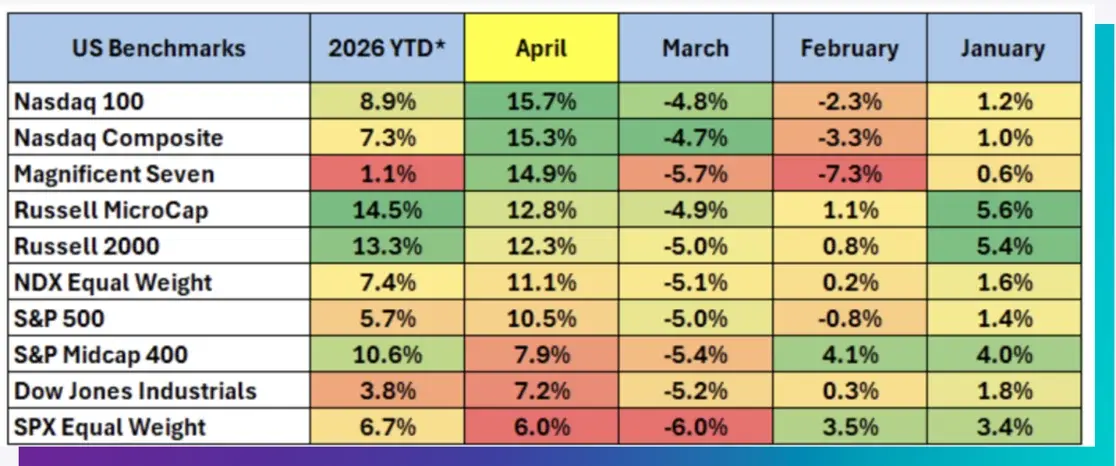
Here’s a quick snapshot of how markets moved recently:
Let’s cut through the noise and talk about what actually happened in April.
Stocks had a strong month. The S&P 500 was up around 10.5%, and the Nasdaq-100 climbed over 15%. AI investment continued to drive optimism, and some easing of tension around the Iran conflict helped push markets to new all-time highs.
But every day, Americans aren’t feeling it. Consumer sentiment hit its lowest recorded level in April. Gas prices climbed. Inflation is still real. And rate cuts in 2026? Markets aren’t expecting much. There’s a disconnect right now between what Wall Street is celebrating and what people are actually experiencing at the pump and the grocery store.
The world is still complicated. The conflict in the Middle East isn’t just an energy story. It’s creating supply disruptions across aerospace, agriculture, and technology—including helium, jet fuel, and fertilizer. These things ripple. That’s why having a plan that accounts for global uncertainty isn’t optional anymore.
The takeaway? Chaos is still out there. But panic doesn’t help anyone. Markets can rise even when confidence is low, and that’s exactly why staying steady and sticking to your long-term plan matters more than reacting to headlines.
Want the full April breakdown?
What We're Watching Right Now
A few things worth paying attention to this month:
- The Fed isn’t moving yet, but the question is what comes next. Rates are expected to hold for now. That affects what you’re earning on cash, what you’re paying to borrow, and how your portfolio is positioned. Worth a conversation if you haven’t revisited that lately.
- Markets are at new highs. Strong earnings and tech momentum pushed major indexes higher through April. That’s good news — but it’s also the moment when people start asking how much risk they’re really comfortable with. If you haven’t thought about that question in a while, now’s a good time.
- You may be able to save more for retirement in 2026. The 401(k) limit is now $24,500. And if you’re between 60 and 63, there’s a new “super catch-up” provision that lets you put away even more. If you’re serious about your financial future, this is one of the most straightforward opportunities out there right now.
- Energy prices are still a factor. Oil has been unpredictable this spring, and that flows through to gas prices, inflation, and market sentiment. It’s one of those variables that reminds you how connected everything is.
- Planning actually changes how people feel about retirement. Recent research backs this up—people who have a plan feel significantly more confident. That’s not a surprise to me. It’s what I see every day.
All of this is a reminder that your plan should reflect where things stand today — not where they were a year ago.
For more, visit the Prime Capital Financial blog.
 Joe Harrish